


Estimated Reading Time: 9 Minutes
As a sex and health journalist, I hear one specific question constantly: “Is all this porn and masturbation ruining my sex life?” Undoubtedly, this is a common anxiety. Many people worry it will lead to serious issues, including Erectile Dysfunction (ED). They fear they’re “breaking” their brain and, consequently, will be unable to perform with a real partner.
However, what if this fear, while valid, is misplaced?
In reality, the problem might not be porn itself, but something far more common. The real culprit for a dwindling sexual desire is often not what you watch, but predictability. Specifically, this is the great human paradox. We love comfort and routine; we are creatures of habit. Yet, our brains are wired for novelty. That same predictability that makes us feel safe is simultaneously the ultimate killer of sexual arousal. It is a classic case of habituation and boredom, and it is a massive factor in our modern loss of desire.

The Predictability Trap
Furthermore, we need to understand why routine is so damaging to libido. When a relationship becomes purely predictable, the brain stops releasing the dopamine required for high arousal. Therefore, when patients come to me worried about their performance, I often look at their daily habits first. Ultimately, breaking out of this “predictability trap” is essential for maintaining long-term desire.
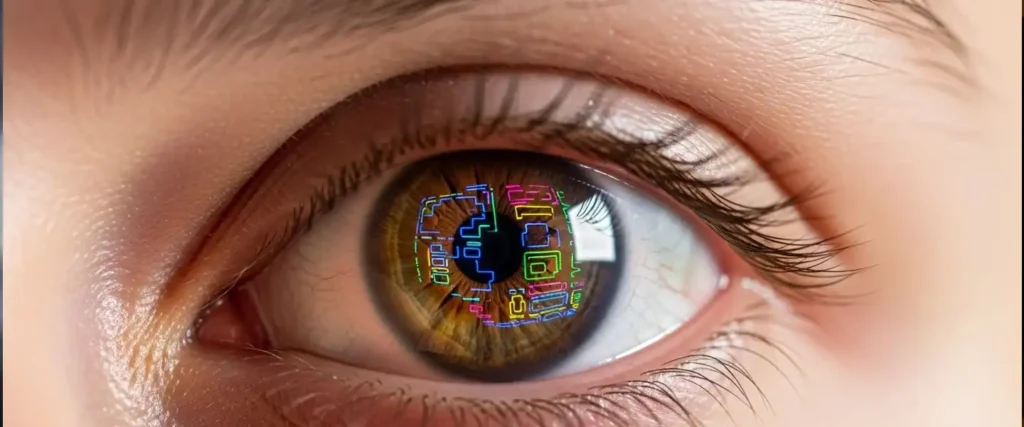
Fantasy, Porn, and the Fear of Erectile Dysfunction (ED)
Let’s be clear: pornography is fundamentally a fantasy delivery system. It offers a venue for sexual fantasy that is instant, intense, and always available. This is especially true for “naughty” or “forbidden” topics. Why? Because they represent the unexpressed, the exotic, or the thing we don’t have in our everyday lives.
Nevertheless, this isn’t inherently a bad thing. Fantasy is a normal, healthy part of human sexuality. The real problem, the disconnect, happens when these fantasies are kept secret.
Subsequently, this secrecy builds a wall between partners. It creates what experts call “moral incongruence,” which is a fancy term for the shame and guilt you feel when your private habits don’t align with your relationship values.
The Danger of the “Instruction Manual”
Moreover, there is a distinct danger for young adults who start using porn as an instruction manual. They see something extreme and immediately try to replicate it without any real sexual communication or understanding of safety. As a result, this can lead to intense performance anxiety. And what does performance anxiety often lead to? You guessed it: psychogenic Erectile Dysfunction (ED).

Communication: The Best Antidote to Sexual Boredom
That shame I just mentioned? Unfortunately, it creates a “negative cloud” that hangs over a relationship. The biggest barrier I see in long-term couples is a paralyzing fear of judgment. Because you’re afraid to tell your partner what you really want, you both get stuck in a rut. Consequently, the relationship intimacy suffers.
In contrast, you would be amazed at the therapeutic power of just talking. For instance, many clinical studies for loss of desire find that even the placebo groups get better. Why? Simply because, for the first time, they are in a setting where they are finally allowed to talk about their sex lives.
How Silence Fuels Erectile Dysfunction (ED)
Getting those pent-up feelings out lifts a massive weight. Therefore, talking is the most effective tool we have against sexual habituation. Furthermore, reducing this emotional weight lowers the anxiety that can contribute to performance issues like Erectile Dysfunction (ED).
💡 Pro Tip: Start small. You don’t need to share your deepest fantasy tonight. Instead, try a ‘fantasy scale.’ Ask your partner, “On a scale of 1 (same old) to 10 (wildly adventurous), what are you in the mood for?” This opens the door for
sexual communicationwithout pressure.
Brain Synchrony: A Deeper Look at Connection
Here’s where things get really fascinating. When you truly connect with a partner, your bodies literally sync up. Scientists call this physiological synchrony.
Specifically, researchers can put EEG caps on a couple and see their brainwaves fire at the same time when they recall a shared memory. This brain synchrony is the biological signature of a deep bond and is part of the core brain chemistry and sex. Similarly, this connection even shows up in how you move. Ever notice how you and your partner fall into the same walking pace? That is synchrony.
The Role of Stress in Erectile Dysfunction (ED)
However, when couples drift apart, this connection breaks. The signals stop aligning. Significantly, this loss of connection is a major source of stress in a relationship. This stress is a well-known psychological trigger for Erectile Dysfunction (ED). In other words, it’s not a mechanical failure; it’s a connection failure. Your brain is essentially “tagging” the experience as stressful, not pleasurable.
📈 Pro Tip: Rebuild
brain synchronyoutside the bedroom. For example, go for a walk and consciously try to match your partner’s footsteps. Alternatively, try a non-sexual activity where you must cooperate, like cooking a complex new recipe. This rebuilds the neural pathways of connection.
The Brain on Sex: A Quick Guide to the Physiology of Orgasm
So, what is actually happening in your brain during sex? It is a powerful chemical cocktail.
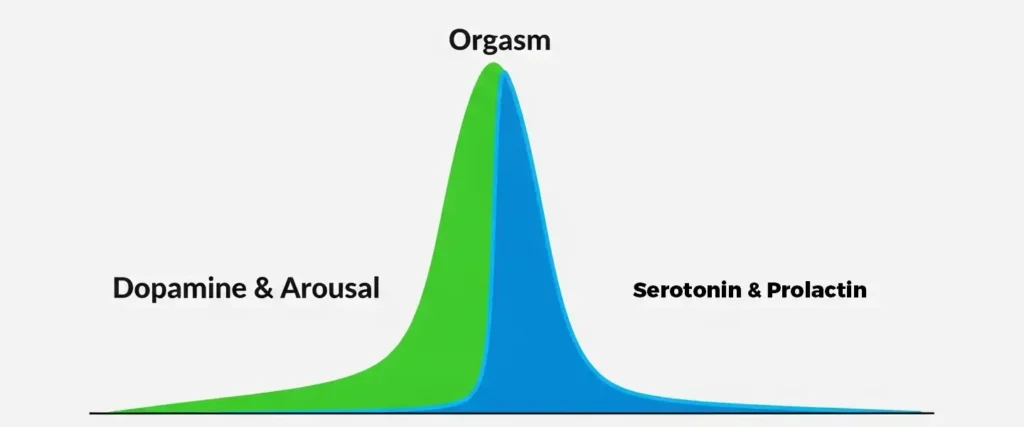
First, sexual arousal is driven by a rise in Dopamine (the motivation chemical) and noradrenaline (the excitement chemical). This is the dopamine and arousal system kicking into high gear. Eventually, this builds to the climax, a “point of no return” triggered by the sympathetic nervous system.
Then, the finale occurs. At the moment of orgasm, your brain floods with opioids (which bring pleasure) and a massive wave of serotonin.
Understanding the “Refractory Period”
This serotonin flood is key. Essentially, it acts as the “mission accomplished” signal. But what does it do? It shuts down the dopamine and arousal system.
Consequently, this “dopamine crash” is the direct cause of the refractory period—that time when you temporarily lose interest. It is a natural, healthy process. For some men, anxiety about this recovery time can even be misdiagnosed as Erectile Dysfunction (ED), when it is just normal biology. To prove this, doctors can see a spike in the hormone prolactin right after orgasm, which only happens when dopamine drops. This is the physiology of pleasure in action.
Reigniting Desire: Why “Playing” Beats “Working”
Let’s put this all together. If your sex life is boring, the problem is the habit, not the partner.
I have seen people chase relationship novelty by having an affair. But this just repeats the cycle. Inevitably, the new, exciting partner becomes the new, boring habit.
Therefore, the solution is to reframe the entire concept. People hate “working” on their sex lives because it sounds like a chore. So, stop “working” and start “playing.”
Remember being a kid? Play was about exploration and fun, not goals. That is what you need to bring back. For example, change the context. Don’t just relegate sex to the bed at 11 PM. Be spontaneous. Try the kitchen. Rent a hotel room for an afternoon. Ultimately, the goal is to break the predictable pattern and re-introduce the thrill of the unpredictable. This is how you fight sexual habituation and improve your men sex health.
🗣️ Pro Tip: Create a “fantasy jar.” You and your partner each write down 5-10 tame, exciting, or new ideas on separate slips of paper. Once a week, pull one out. No judgment, just play. This is a simple way to build
relationship intimacy.
Your Takeaway: Arousal Is a Practice, Not a Given
So, back to our original question. Is porn the problem?
Sometimes, it can be a factor in performance anxiety or even psychogenic Erectile Dysfunction (ED). But more often, it is a symptom of a deeper issue: boredom.
Here is what I want you to remember:
- First, habit is the true enemy of arousal, not fantasy.
- Second, fantasies are healthy, but secrecy and shame are damaging.
- Third, open
sexual communicationis your single most powerful tool for buildingrelationship intimacy.
Finally, you can actively cultivate desire. You can choose “play” over “work.” A passionate, long-term sex life doesn’t just happen to you. On the contrary, it is something you create, together, every single day.

Q&A: Your Top Questions Answered
1. Does watching porn or masturbating make it harder to connect with a real partner? It can, but not for the reasons you think. The problem isn’t the act; it’s the secrecy and habit. If you’re secretly engaging in fantasies that are far more intense than your reality, your brain can get “habituated” to that high level of arousal. Consequently, this can make your partner seem less exciting. The fix isn’t to stop, but to communicate. Use your fantasies as a starting point to talk about what truly excites you.
2. If sex becomes boring, does it mean the relationship is over? Absolutely not. It means you’re normal. In fact, every single long-term relationship hits a point of habituation and boredom. It is a sign that you’ve gotten comfortable, not that you’ve fallen out of love. Specifically, it’s simply a signal that it’s time to stop “phoning it in” and start actively “playing” and introducing relationship novelty again.
3. Is masturbation healthy? Yes. From a physical standpoint, it is a perfectly healthy, normal part of human sexuality for all genders. Moreover, it helps you understand your own body, learn your own physiology of pleasure, and can be a great stress reliever. It only becomes a problem when it is used as an escape to avoid intimacy or when it is surrounded by so much shame that it impacts your mental health.
4. How can I talk to my partner about porn? Start from a place of curiosity, not accusation. For instance, don’t say, “Why do you watch that?” Instead, try, “I’m curious about the things you find arousing. I’d love to know more about your fantasies.” The goal is to make it a shared exploration, not an interrogation. Ultimately, this turns pornography and relationships from a conflict into a conversation.
5. Does porn change your brain? Everything changes your brain. Learning to ride a bike changes your brain. The real question is whether it is harmful. For most people, it is not. However, for some, the constant, high-novelty, high-dopamine rush can make real-world intimacy feel “slower” or “less exciting” by comparison. This is a form of habituation. The good news is, brains are “plastic.” By focusing on real-world connection and communication, you can “retrain” your brain to find deep pleasure in partner-based intimacy.

 By
By

 By
By
 By
By binance h"anvisningsbonus says:
  binance h"anvisningskod says:
  注册免费账户 says:
  www.binance.bh注册 says:


