


Introduction
As a physician specializing in men’s sexual health, I often see patients who are physically healthy but emotionally hollow. They come to me seeking prescriptions for libido, yet their blood work is normal. The missing link is often found in the brain’s reward circuitry. Understanding the intricate relationship between sexual health and dopamine is the single most important step you can take to reclaim your drive, your focus, and your intimate satisfaction.

Dopamine is far more than just a “feel-good” chemical; it is a neuromodulator that orchestrates the activity of vast neural circuits. It is the universal currency of our biology, driving us to forage for resources, seek partners, and move toward goals. However, in our modern world of endless digital stimulation and instant gratification, our internal “kinetics”—the schedules of dopamine release—have become dysregulated. If you feel unmotivated or find that intimacy has lost its spark, it is rarely a moral failing. It is often a matter of biology. By mastering the mechanics of this powerful molecule, you can control your quality of life and restore the deep sense of wellbeing that you deserve.
Understanding Your Brain’s “Drive” Molecule
To understand why your motivation might fluctuate, we have to look “under the hood” of your nervous system. Many people confuse dopamine with sensory pleasure, like the taste of sugar on your tongue. But its role is much more profound.
Neuromodulators vs. Neurotransmitters
Dopamine functions as a neuromodulator, which distinguishes it from standard neurotransmitters. While neurotransmitters handle the direct dialogue between specific neurons, neuromodulators like dopamine act like a conductor, influencing the volume and communication style of huge groups of neurons at once. This means that a release of dopamine changes the probability that certain neural circuits will fire while silencing others.
Pro Tip: Think of dopamine not as the finish line, but as the fuel. It isn’t just about the reward; it is the chemical driver that pushes you to go get the reward. ⛽
Key Functions of Dopamine
It is a common misconception that dopamine is solely responsible for pleasure. In reality, it governs motivation, drive, and craving. These three sensations—wanting, seeking, and pursuing—are chemically distinct from the feeling of “liking” something. Perhaps most surprisingly, dopamine also controls your perception of time. When your dopamine is high, you are laser-focused, and time seems to dilate or contract based on your engagement. This is critical for sustaining effort over long periods, which is essential for being a happy, high-functioning person.
The Science of Dopamine: Beyond Just “Pleasure”
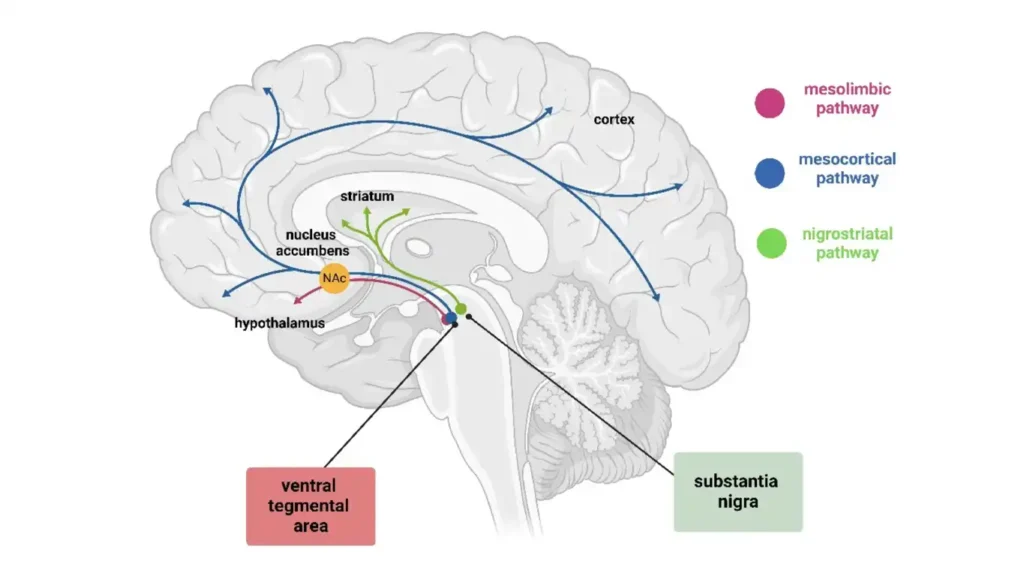
When we talk about sexual health and dopamine, we are really talking about two specific pathways in the brain that this molecule travels along.
The Two Main Brain “Tracks” for Dopamine
Your brain has two primary highways for dopamine, and they serve different but related purposes.
The Movement Pathway
The first is the nigrostriatal pathway, which connects the substantia nigra to the dorsal striatum. This circuit is vital for initiating physical movement. It’s why you might see a “shuffling” gait or difficulty starting a movement in people with Parkinson’s disease, where dopamine neurons in this region have depleted or died.
The Motivation Pathway
The second, and arguably more relevant for our discussion on intimacy, is the mesocorticolimbic pathway. This is the reward, reinforcement, and motivation circuit. It connects the deep, primal parts of your brain to the prefrontal cortex—the area responsible for planning, thinking, and assigning rational meaning to your experiences.
Clinical Context: What Happens When We Run Low?
In conditions like Parkinson’s disease or Lewy body dementia, the death of dopamine neurons leads not only to tremors but also to significant drops in affect and motivation. Patients often become depressed not just because they are ill, but because the chemical driver for “mood” is physically missing. When treated properly, however, they can recover fluidity of movement and psychological well-being. This proves that your mental state is deeply tethered to your biological dopamine levels.
The Dopamine “Set Point”: Peaks vs. Baseline
This brings us to the most critical concept for your daily life: the baseline. Your experience of life—your joy, your drive, your sexual desire—is not determined by how much dopamine you have in total, but by how much you have right now relative to what you had a few minutes ago.
Why the Baseline Matters
Imagine your dopamine level is a tide. Waves (peaks) can crash onto the shore, but the tide (baseline) determines the overall water level. If you constantly trigger massive waves, the tide eventually recedes. Your “dopamine set point” is that baseline level. Maintaining a healthy baseline is critical because if it drops too low, even things you used to love will fail to register as pleasurable.
Quality of Life
Your subjective experience of satisfaction depends entirely on this delta—the difference between your baseline and the peak. If your baseline is already chronically low due to burnout or overstimulation, you will feel lethargic and unmotivated. Conversely, if you protect your baseline, you remain capable of experiencing deep joy.
The Impact of Common Activities on Sexual Health and Dopamine Levels
To manage your sexual health, you must understand how different inputs affect your system. Different activities spike dopamine to varying degrees.
| Activity/Substance | Dopamine Increase (Above Baseline) | Duration/Notes |
| Chocolate | ~1.5 times | Transient; goes away in minutes |
| Sex (Pursuit & Act) | ~2.0 times | Essential for species survival; drives foraging & seeking |
| Exercise | 0 to 2.0 times | Highly dependent on if you enjoy the exercise |
| Nicotine (Smoked) | ~2.5 times | Very short-lived; quickly metabolized |
| Cocaine | ~2.5 times | High peak followed by a severe crash below baseline |
| Amphetamines | ~10 times | Tremendous increase; leads to severe depletion |
Have you ever noticed that the pursuit of a partner feels more “electrifying” than the relationship settling into comfort? That is dopamine driving the “seeking” behavior.
The “Dopamine Crash” and the Trap of Addiction
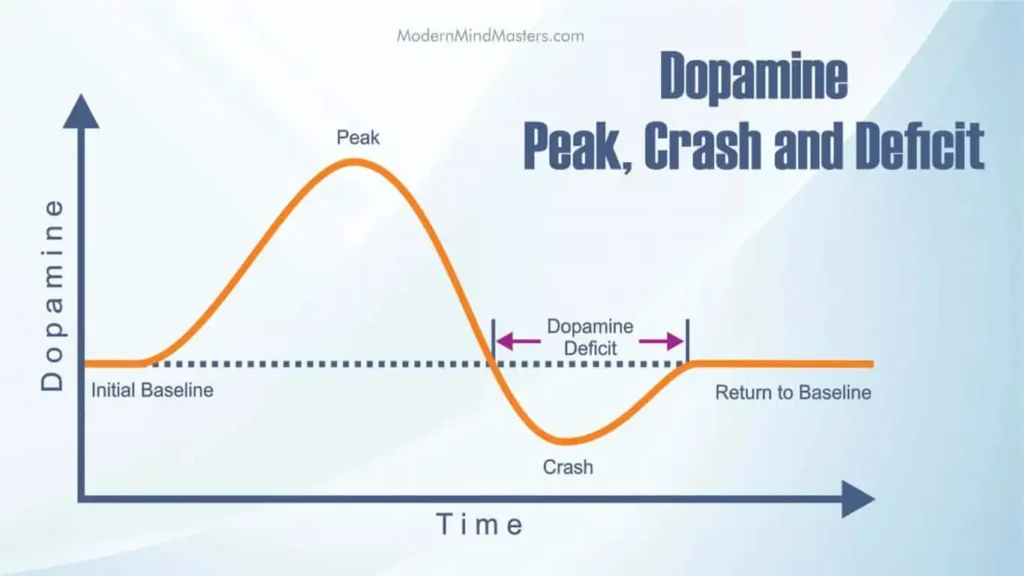
What goes up must come down. This is the iron law of neurobiology. After a dopamine peak, your levels do not simply return to baseline—they drop below it32.
What Goes Up Must Come Down (Below Baseline)
This drop is what I call the “valley.” The depth of the valley is usually proportional to the height of the peak. If you spike your dopamine to 10x with a substance, the crash will be profound. This transient deficit state is why people often feel let down, empty, or irritable immediately after a high-intensity experience.
The Readily Releasable Pool
Why does this happen? Visualize dopamine stored in tiny bubbles called synaptic vesicles inside your neurons. These vesicles are your “readily releasable pool”. When you trigger a massive release, you are essentially dumping out all the bubbles at once. Until your body can synthesize and package more dopamine, the pool is empty.
The Cycle of Depletion
Here lies the trap. When we feel that drop—that “blah” feeling—our instinct is to go back to the activity that gave us the high. We think it will bring us back up. But because the pool is depleted, it doesn’t work. Instead, we dig the hole deeper, pushing our baseline lower and lower.
Clinical Context
This is the definition of addiction: the progressive narrowing of things that bring you pleasure. Eventually, the “high” isn’t even pleasurable anymore; you are just doing it to feel normal. In my practice, I see men who have desensitized themselves through hyper-stimulating digital content or substances, leading to a state where real-world intimacy feels “boring” by comparison. This is a tragedy of biology, but it is reversible.
Pro Tip: If you feel a “crash” after a great weekend or a big success, don’t panic. Wait it out. Do not chase another high immediately. Let your pool refill naturally. 🧘
Strategies to Protect and Optimize Your Sexual Health and Dopamine
The goal is not to eliminate pleasure but to manage the “kinetics” so you can sustain it for a lifetime.
The Power of Intermittent Rewards
If you want to keep your motivation for intimacy alive, you must embrace intermittent rewards. This is the secret sauce of casinos—they don’t let you win every time. If you won every pull of the slot machine, you’d get bored. The uncertainty keeps the dopamine system engaged.
Utilizing Sexual Health and Dopamine Protocols in Relationships
In a relationship, this translates to keeping some mystery and unpredictability. It means not expecting a “10 out of 10” experience every single time. By allowing for quiet, lower-dopamine moments, you actually preserve your ability to experience the peaks.
Reward Prediction Error
Dopamine is heavily influenced by “reward prediction error”. If you expect a huge reward and get it, dopamine spikes moderately. If you don’t expect it and get it, dopamine spikes massively. If you expect it and don’t get it, dopamine drops below baseline. Managing your expectations is a powerful tool for satisfaction.
Cold Water Exposure for Sustained Energy
One of the most effective tools for raising your baseline—not just a peak—is deliberate cold exposure.

The Mechanism
Research shows that immersing yourself in cold water (roughly 50°F to 60°F) can cause a sustained rise in dopamine of up to 2.5 times above baseline.
Unique Benefit
Unlike cocaine, which spikes and crashes, cold exposure causes a slow, steady rise that can last for hours, keeping your baseline elevated. This leads to a state of calm focus and resilience. Many of my patients report that this practice significantly improves their mental clarity and “drive” in other areas of life.
Safety Note
Please be careful. Entering very cold water (below 50°F) can cause cold water shock, which is dangerous. Start slow, perhaps with cold showers, and adapt over time.
Cultivating a “Growth Mindset” Through Effort
Your mindset can literally alter your brain chemistry. This is particularly true for sexual health and dopamine, where the effort of building a relationship must be perceived as rewarding in itself.
Intrinsic vs. Extrinsic Reinforcement
A classic study at Stanford demonstrated this beautifully. Children who loved to draw were given gold stars (extrinsic rewards) for drawing. Later, when the gold stars were removed, the children stopped drawing. The reward had replaced the intrinsic joy of the activity.
The Danger of “The Trophy”
When we focus only on the “finish line”—whether that’s an orgasm, a promotion, or a number on a scale—we dissociate from the pleasure of the process. This makes the work feel harder and the satisfaction more fleeting.
Learning to Love the Friction
We can train our brains to access the “pleasure from effort” pathway.
The Tool
Use your prefrontal cortex to consciously tell yourself: “This is hard, and I am choosing to do it because I want to.”. By reframing friction as a positive signal, you can release dopamine during the struggle, not just after.
Practical Application
In your sexual health journey, this means valuing the connection, the vulnerability, and the “work” of intimacy as much as the climax. This shifts your dopamine schedule from a “peak-and-crash” model to a sustained, healthy burn.
The Golden Rule
Do not spike your dopamine before you engage in effort (like taking a stimulant to “get in the mood”) and don’t spike it immediately after. Learn to spike it from the effort itself.
Compounds and Supplements: A Clinical Perspective
While behavioral tools are primary, there are compounds that can support your system.
Prescription and Over-the-Counter Options
Wellbutrin (Bupropion)
Clinically, we sometimes use Wellbutrin (Bupropion) for depression. Unlike SSRIs, which can blunt libido, Wellbutrin acts on dopamine and norepinephrine, often sparing or even helping sexual function.
L-Tyrosine
L-Tyrosine is an amino acid precursor to dopamine. It can provide a temporary boost in focus, but be aware: what goes up must come down. You may experience a crash about 30–45 minutes after the peak.
Yerba Mate
A fantastic natural option is Yerba Mate. Not only does it provide caffeine, but it also contains compounds that are neuroprotective for dopamine neurons. It can help upregulate dopamine receptors, making your existing dopamine work better.
Pro Tip: Avoid energy drinks with excessive sugar. Try Yerba Mate tea instead to get a gentle lift while protecting your brain cells. 🧉
Maintaining Your Dynamic Range
Ultimately, the goal is to keep your dopamine system sensitive. You want to be able to enjoy the small things—a cup of coffee, a walk, a quiet moment with a partner.

Social Connection
Never underestimate the power of social connection. Oxytocin and dopamine interact powerfully. Close, healthy relationships are one of the most potent stimuli for our reward pathways.
Dr. Usman Arif: When we repeatedly chase high-intensity dopamine peaks, we inevitably deplete our readily releasable pool of neurons, causing a baseline drop that numbs our ability to feel genuine satisfaction in future intimate encounters.
I noticed that the more I prioritized immediate gratification and “high-peak” activities, the less I actually looked forward to the quiet, meaningful moments of connection that used to define my happiness. It felt like I was running on an empty tank, where even the most exciting experiences started to feel dull and routine. Only by stepping back and allowing my baseline to reset did I rediscover the drive and focus that makes daily life feel vibrant again.
Your past choices shape your current chemical reality. But the beautiful thing about neuroplasticity is that you can change. By respecting your baseline and choosing sustainable sources of drive, you can secure your motivation and satisfaction for the long haul.
Comparison Table: Dopamine Management for Sexual Health
| Strategy | Mechanism | Effect on Baseline | Sexual Health Benefit |
| Cold Exposure | Increases dopamine & norepinephrine | Raises & sustains baseline | Increases resilience & energy for intimacy |
| Intermittent Rewards | Unpredictable dopamine release | Prevents receptor downregulation | Keeps desire & mystery alive in relationships |
| Growth Mindset | Dopamine release from effort | Stabilizes baseline | Makes the “work” of relationships feel rewarding |
| High Stimulants | Massive dopamine dump | Lowers baseline (Crash) | Can lead to desensitization & lower libido |

 By
By
 By
By


