


Estimated Reading Time: 12 minutes
Introduction: Understanding the Orgasm Gap
Let’s start with a statistic that I see the consequences of in my medical practice every single week. Specifically, studies show that about 95% of heterosexual men report they usually or always orgasm during sex. However, for heterosexual women, that number plummets to around 65%.
Unfortunately, this constitutes the “orgasm gap.” As a urologist, pelvic surgeon, and health journalist, I can tell you this gap isn’t because female bodies are “complicated” or “mysterious.” Rather, it is because most of us (men and women alike) were never given the correct owner’s manual.
Currently, we live in a world where our primary form of sex education often comes from pornography, not physiology. Porn, however, is performance, not reality. Consequently, it creates a picture of intimacy that is often inaccurate and focused on goals that have very little to do with genuine female pleasure.
As a result, this leaves countless people feeling confused, inadequate, or broken. But what if the map we’ve been given is just… wrong?
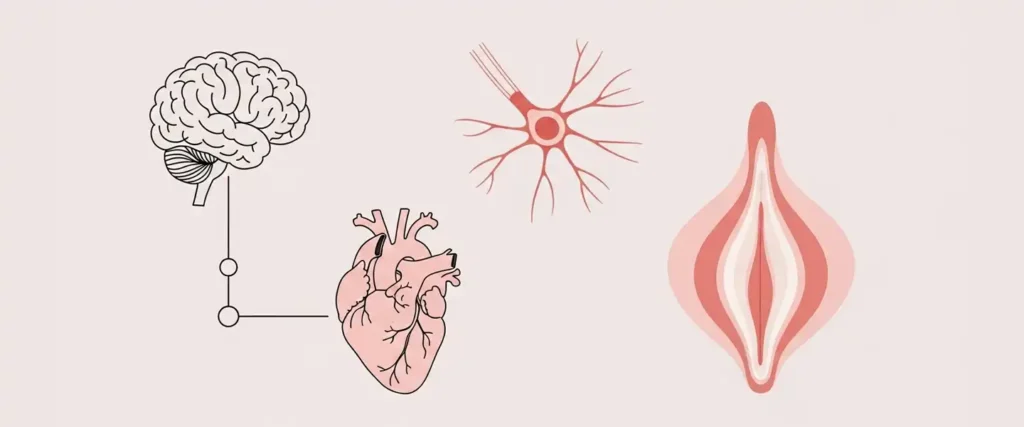
In this post, I’m going to pull back the curtain on the real science. First, we’re going to bypass the myths. Then, I will give you the facts. We’ll cover essential female anatomy, the truth about the G-Spot, the real stages of female arousal, and the practical techniques that actually work. It’s time to close the orgasm gap, and it starts with understanding the facts about the female orgasm.
The Blueprint: An Essential Guide to Female Anatomy
First things first: basic vocabulary. Most people use the word “vagina” to refer to everything “down there.” Technically, this is incorrect. The vagina is the internal muscular canal. In contrast, the entire external genital area is called the vulva. This includes the outer lips (labia majora), the inner lips (labia minora), the urethra (where urine comes out), the vaginal opening, and, most importantly, the clitoris.
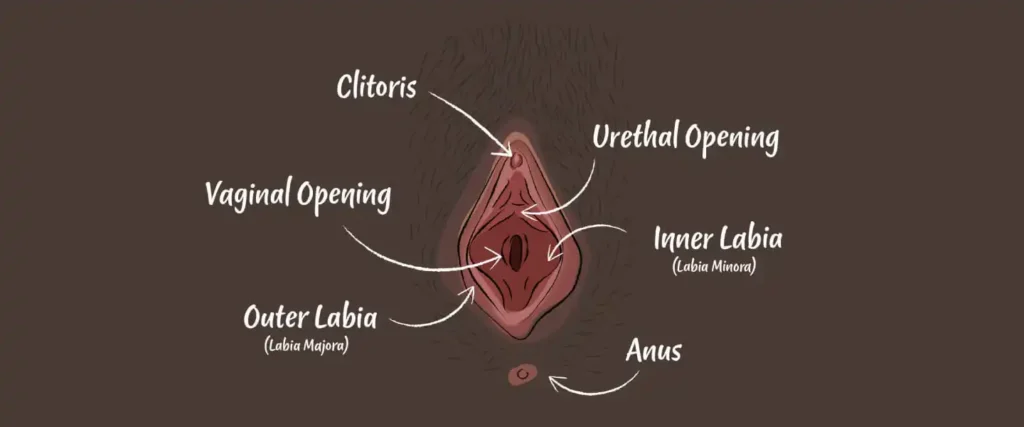
Knowing this distinction is the first step in proper sex education and better communication with a partner.
The Clitoris: The Main Event for Female Pleasure
If you learn only one thing today, let it be this: Remarkably, the clitoris is the only organ in the human body that exists for one reason and one reason only: pleasure.
The little “button” you can see externally is, quite literally, just the tip of the iceberg. In reality, the clitoris is actually a large, complex, internal organ. It has a shaft and two “legs” (called crura) that extend deep into the pelvis, wrapping around the vagina. Therefore, this is, without a doubt, the control center for the female orgasm.
Furthermore, recent research discovered it has over 10,000 nerve endings. That is more than twice as many as the head of the penis. Think about that for a second. Additionally, the clitoris is homologous to the penis; they develop from the exact same tissue. This means the clitoris also engorges, swells, and becomes erect (hard) when aroused. It is the star of the show.
💡 Pro Tip: Because the clitoris and penis are made of the same tissue, much of what feels good for one (like varied pressure, rhythm, and gentle touch) often feels good for the other. It’s the body’s most reliable route to how to achieve orgasm.
Other Key Areas
- Labia (Majora and Minora): These are the outer and inner “lips.” A quick note I always tell my patients: their size, shape, and color vary enormously from person to person. In short, variation is the norm.
- Vagina: This is the muscular tube that connects the vulva to the cervix. It is incredibly elastic but has very few nerve endings, especially in the upper two-thirds.
- Perineum: This is the small area of skin between the vaginal opening and the anus.
Deconstructing the Myths: The G-Spot and Squirting
Now, let’s tackle the biggest myths that cause so much pressure and confusion in the bedroom. As a surgeon, I love dispelling myths with anatomy. How much time, anxiety, and effort have we wasted hunting for something that isn’t even a “thing”?
The Truth About the G-Spot
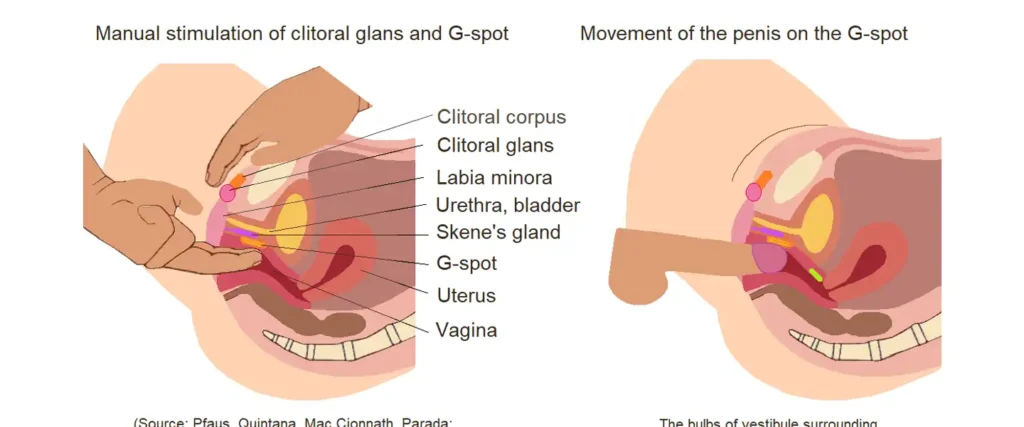
Let’s be perfectly clear: The G-Spot is not a magical, single anatomical “spot” or button. Consequently, the G-Spot myth has caused endless confusion.
What people call the “G-spot” is actually a “zone” on the front (anterior) wall of the vagina, about one to two inches inside. But what are you actually stimulating when you press there? Essentially, you are stimulating the internal parts of the clitoris through the vaginal wall.
This area is simply a convergence of sensitive structures: the internal clitoral legs, the urethra, and the Skene’s glands (sometimes called the “female prostate”).
This explains why pleasure here varies so intensely. Some women love stimulation in this zone. On the other hand, for others, it feels like nothing special. Moreover, for many, it’s actually uncomfortable because the pressure on the urethra just makes them feel like they have to pee. All of these responses are 100% normal.
So, my advice? Stop “hunting” for it. Instead, focus on overall pleasure and listen to your partner.
Squirting Explained
Another phenomenon glamorized by porn is squirting. This has put enormous pressure on women to do it and on partners to “make” it happen.
The reality? Studies suggest only 10-54% of women have experienced it. Squirting explained scientifically is simple: the fluid is not urine, but it does come from the bladder. Specifically, it’s a clear, diluted fluid that gets filtered through the bladder and mixed with secretions (like PSA) from those same Skene’s glands.
Ultimately, it is not the mark of a “better” orgasm or the ultimate sign of pleasure. It’s just a physiological response that some people have and some don’t. Therefore, it should never be a goal or a source of pressure for either partner.
The Art of Arousal: A Process, Not a Switch
Here is one of the most critical differences that impacts men sex health and their relationships: Female arousal is a process, not an on/off switch.
Time is Key
For most men, the arousal process from zero to “ready for intercourse” can take 2 to 5 minutes. Conversely, for most women, that same process takes 15 to 45 minutes.
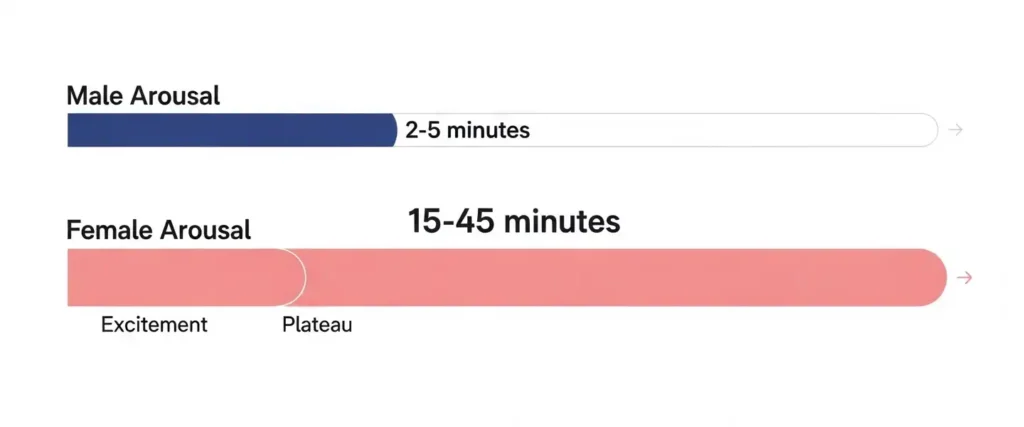
Read that again. 15 to 45 minutes. This isn’t a preference; it’s physiology. Her body needs this time for blood to flow, tissues to swell, and natural lubrication to be produced. When was the last time foreplay truly lasted 20 minutes before penetration was even on the table?
The Stages of Arousal and the Climactic Female Orgasm
- Excitement: This is when it all begins. Blood flow to the genitals can increase by up to 300%. The clitoris swells, and the vaginal walls begin to produce lubrication. Simultaneously, the vagina gets longer and wider at the top, a process called “vaginal tenting.”
- Plateau: Things intensify. The clitoris may seem to “disappear” as it retracts under its hood for protection because it’s so sensitive.
- Orgasm: This is the climactic phase. A female orgasm is a series of rhythmic muscular contractions in the pelvic floor, uterus, and anus. Interestingly, it typically lasts much longer than a male orgasm, anywhere from 10 to 60 seconds.
Why Foreplay is Non-Negotiable
Rushing to penetration before the “vaginal tenting” process is complete is why sex can be uncomfortable or even painful. Basically, her body isn’t ready to accept penetration. Therefore, foreplay (kissing, touching, oral stimulation) isn’t an optional appetizer; it’s the main course for arousal.
A Note on Lubricant
Let’s break a stupid stigma right now. Wetness does not always equal arousal, and a lack of wetness does not mean she isn’t turned on. In fact, natural lubrication is affected by a thousand things: her menstrual cycle, stress levels, hydration, medications, and age.
Use lubricant. It’s one of the best intimacy tips I can offer. Lube isn’t a sign of failure; rather, it’s a tool for better, more comfortable, and more fun sex for everyone.
📈 Pro Tip: Think of lube as an enhancer, not a replacement. For instance, use a high-quality water-based or silicone-based lubricant to reduce friction. This simple step can dramatically increase female pleasure, especially during longer sessions.
Beyond the Physical: The Mental Side of the Female Orgasm
This is, in my opinion, the most overlooked part of the female orgasm. For most women, the brain is the biggest sex organ. Consequently, emotional safety and mental relaxation are not just “nice to have”; they are crucial.
“Spectatoring”: Are You In Your Head?
A huge barrier to pleasure is a concept called “spectatoring.” Essentially, this is when you’re “in your head” during sex, monitoring yourself instead of feeling.

She might be thinking, “Am I taking too long to climax?” “Do I look okay from this angle?” “Is he getting bored?” or “Why can’t I just relax?” Do you ever find yourself watching yourself during sex, rather than being in the moment? Unfortunately, this mental chatter is the enemy of arousal. It pulls you out of your body and makes it almost impossible to relax into pleasure.
How Partners Can Help
This is where connection becomes so important. Here are three specific ways to help:
- Offer Reassurance: Genuine compliments and words of affirmation go a long way. Tell her she looks beautiful. Also, tell her you’re enjoying the process with her.
- Focus on Connection, Not a Goal: Make the goal intimacy and pleasure, not just an orgasm. As a result, this takes all the pressure off.
- Build Intimacy All Day: We have a saying: “Foreplay starts in the morning.” Intimacy isn’t just what happens in the 30 minutes before bed. First, it starts by sending a nice text. Then, it continues by showing affection without demanding sex. Finally, it includes helping with household chores so she’s less stressed. This builds the foundation of desire and emotional safety.
Practical Advice: 7 Common Sex Mistakes to Avoid
As a health journalist, I see people making the same common sex mistakes because they’re following that “porn map” instead of the “physiology map.” Therefore, here’s how to get on the right track.
1. The “Doorbell” Mistake
The clitoris is highly sensitive. Please, don’t just “mash” it like a doorbell. Start gently, not directly on the head, but on the sides or through the clitoral hood. Then, listen and watch for her feedback.
2. The “Jackhammer” Mistake
Fast, hard, repetitive motion might work in porn, but in real life, it’s often overwhelming or just… boring. Instead, most women prefer varied rhythm, pressure, and movement. Follow her cues.
3. The “Switch-Up” Mistake
This is a huge one. Your partner is breathing harder, moving towards your touch… and then you suddenly switch to something completely different. No! If something is working, keep doing it. Consistency is what builds intensity toward climax.
4. The “Self-Centered” Mistake
Stop making it about your performance. The moment you start thinking, “I need to make her climax,” you’ve made it about your ego, not her pleasure. Instead, relax and focus on the shared experience.
5. The “Feedback-Ignorance” Mistake
If she moves your hand, don’t get offended. She’s not rejecting you; rather, she’s showing you the map. She is giving you the direct answer to “how to pleasure a woman.” Treat it as a gift, not a criticism.
6. The “Rushing” Mistake
I’ll say it again: Remember the 15-45 minute rule. Penetration before she’s fully aroused won’t be pleasurable and might even be painful.
7. The “Orgasm-Obsessed” Mistake
When you make the orgasm the only “successful” outcome, you create immense pressure. Sometimes she might climax, sometimes she won’t. Ultimately, the intimacy, connection, and fun are the real goals. Ironically, taking the pressure off the female orgasm is often the fastest way to one.
🗣️ Pro Tip: The best intimacy tip I can give you is to learn to narrate. Use simple, non-awkward language. For example, try: “Does this feel good?” or “I love it when you…” or “Show me what you like.” This direct communication is the antidote to the “Feedback-Ignorance” mistake.
Conclusion: The Female Orgasm is a Skill, Not Just an Instinct
Achieving a consistent, joyful female orgasm isn’t magic, and it’s not about finding a secret button. In reality, it’s a skill. Like any skill, it gets better with education, attention, and practice.

The people who have the best sex aren’t mind-readers. They aren’t “naturally” good at it. On the contrary, they are the ones who pay attention to their partners. They are the ones who communicate, stay curious, and prioritize their partner’s pleasure as much as their own.
So, here is your homework: Be a “pleasure detective.” Be curious. Explore without a specific goal. What is one myth you can let go of today to start having better, more connected sex?
Your Questions Answered (Q&A)
1. Do women need a partner or penetration to have an orgasm? Absolutely not. In fact, most women achieve orgasm far more easily from direct clitoral stimulation than from penetration alone. Many women find it easiest to orgasm on their own through masturbation because they can focus completely on what feels good without any pressure or “spectatoring.”
2. Is the G-spot a real “button” that everyone has? No. As we covered, this is a G-Spot myth. The “G-spot” is a zone on the front vaginal wall. Stimulating this area is pleasurable for some (but not all) because you are simply stimulating the large, internal structure of the clitoris through the vaginal wall.
3. What’s the difference between all the “types” of orgasms I hear about, like clitoral vs. vaginal? This is one of the biggest female orgasm myths. Medically speaking, there is only one type of female orgasm, and it always involves the clitoris. Fundamentally, the clitoris is the source. A “vaginal orgasm” is simply a female orgasm that results from stimulating the internal parts of the clitoris via the vaginal wall. Similarly, a “clitoral orgasm” is one that results from stimulating the external part. It’s the same organ, just different ways of activating it.
4. Why do I (or my partner) find G-spot stimulation uncomfortable? This is very common. Remember, that “zone” is also right where the urethra and bladder sit. Therefore, for many women, direct pressure there doesn’t feel sexual at all; it just feels like an urgent need to pee. This sensation can cause anxiety and pull them out of the moment, making it the opposite of relaxing.
5. Can you “lose” the ability to have an orgasm? The ability isn’t “lost,” but it can definitely change. For example, orgasm can become more difficult due to factors like stress, new medications (especially antidepressants), hormonal changes (like menopause or after childbirth), or relationship issues. It’s not gone forever, but it means you may need to adapt, communicate more, and explore new ways to find pleasure that work for your body now.

 By
By
 By
By

 Binance注册 says:
  binance Registrera dig says:

 By
By


