


As a reconstructive urologist, I spend my days helping men restore their dignity and quality of life after trauma, cancer, or chronic disease. I have seen firsthand how difficult it is for patients to navigate the healthcare system when they are frail or battling complex conditions. The walls of a clinic can feel cold and intimidating. This is why I am so passionate about the future of medicine moving back to where it belongs: the home.
Did you know that 98% of people would prefer to live at home in their place of comfort for as long as they can? Yet, as our health needs change, staying put becomes a massive challenge. This brings us to a critical question that every family must ask: what is home health care in today’s world, and how can it help us age with dignity?

In this article, I want to explore the “Aging Forward” mission, a concept championed by experts like Dr. Jeffrey Kong and Dr. Christina Chen from the Mayo Clinic. We will look at how we can shift from reactive sick care to proactive longevity, ensuring we live longer and better.
Understanding What is Home Health Care in the Modern Era
When we think about healthcare, we often picture a sterile doctor’s office. However, for an older adult with seven or eight chronic diseases or perhaps a little dementia, getting to that office is an exhausting ordeal.
The Clinic vs. The Living Room
I have patients who suffer in silence because the logistics of leaving their house are just too overwhelming. Dr. Jeffrey Kong, the founder of WellBe Senior Medical, notes that traveling to a clinic can be incredibly difficult for frail patients. It is often anxiety-provoking and physically draining.

The good news is that the landscape is changing. We have learned that about 90 to 95% of what happens in a primary care doctor’s office can actually be done at home.
- Medical Care at Home: Doctors can now perform a full history and physical exam in your living room.
- In-Home Physical Exams: Routine checks are no longer bound to the clinic.
- Diagnostics: You can draw blood, take an electrocardiogram (EKG), and even do X-rays right at your bedside.
Bringing care to the patient rather than forcing the patient to the care is not just convenient; it is the right thing to do. It improves access and is far more dignified and respectful.
Pro Tip: 💡 If you have a loved one who struggles to leave the house, ask their primary care provider if they offer homebound patient services or can refer you to a visiting physician group.
A Personal Perspective on Advocacy
Advocacy is personal to me, and it is personal to Dr. Kong as well. He shared a story about the importance of making decisions based on what truly matters to the patient. Often, the medical system pushes for aggressive treatments without asking the most important question: “What do you want your life to look like?”
As a clinician, my role—and the role of any good home health provider—is to be a family advocate. We must prioritize quality of life over checking boxes. Have you ever felt that a doctor was treating a disease rather than treating the person?
Defining Care: Skilled Needs vs. Custodial Support
To truly understand what is home health care, we must distinguish between medical needs and daily living support. This is where many families get confused.
Activities of Daily Living (ADLs): The Turning Point
The ability to stay at home often hinges on what we call Activities of Daily Living (ADLs). These are the basic tasks we all do every day without thinking. However, as we age, they can become hurdles.

The five key ADLs are:
- Bathing
- Dressing
- Toileting
- Feeding
- Transferring (moving from a bed to a chair)
When someone cannot perform these tasks, they often find themselves leaving their homes for senior living communities or skilled care facilities. Managing chronic illness at home requires a plan for these ADLs.
The Financial Reality: What is Home Health Care Insurance Coverage?
It is vital to understand the “insurance gap.” Medicare pays for skilled care, but it generally does not pay for the custodial care that actually keeps people independent.
| Type of Care | Examples | Primary Payer |
| Skilled Care | Wound care, IVs, medication setup, physician visits | Medicare / Insurance |
| Custodial Care | Help with bathing, dressing, cooking, cleaning | Private Pay / Medicaid (in some states) |
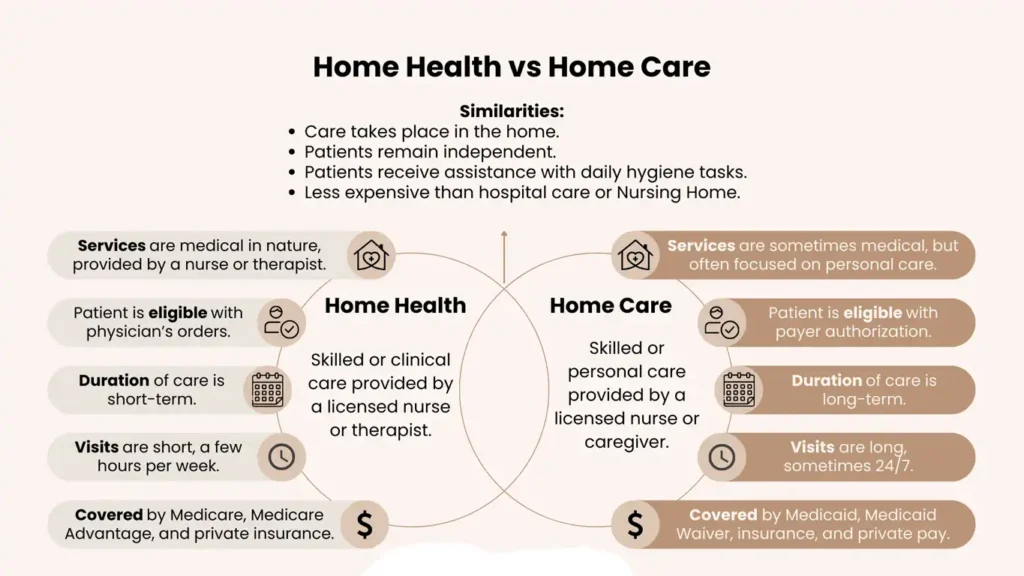
This distinction is crucial. While geriatric home visits from a doctor are covered, the daily help to get out of bed usually is not.
The Reality of Nursing Homes vs. Personalized Home Care
For many of my patients, the fear of a nursing home is real. There is a concern about losing one’s identity.
The Over-Medicalization Trap
In some facilities, there is a risk of over-medicalization. Behavioral symptoms, which might just be an expression of frustration or confusion, can sometimes be met with sedation. Dr. Kong notes that seeing people in their own home is much more patient-centric and comfortable.
In a facility, care is often task-based and delivered by rotating staff. At home, care can be relationship-based.
The “Dignity of Risk”
There is a concept I love called the “Dignity of Risk.” Often, the medical profession wants to put a patient in a facility to prevent a fall. We prioritize safety above all else. But is safety the only metric for a good life?
Sometimes, staying home carries a higher risk. You might fall. But you are in your own chair, looking at your own garden, surrounded by your memories. Informed consent means you have the right to choose that risk in exchange for the comfort of home.
Pro Tip: 🗣️ Have an honest conversation with your doctor about “acceptable risk.” Ask them, “If I stay home, what are the biggest dangers, and how can we mitigate them without me losing my independence?”
Programs for What is Home Health Care Navigation: Innovative Models
So, how do we pay for this? How do we organize it? There are innovative models emerging that aim to fix the fragmented system.
The PACE Program: A Gold Standard
One of the most effective models is the PACE program (Program for All-Inclusive Care of the Elderly). This program integrates Medicare and Medicaid dollars to provide comprehensive medical and social services to certain frail, community-dwelling elderly individuals. It aligns the financial incentives to keep you healthy and at home, rather than paying for expensive hospital stays.
State Resources and Medicaid
Navigating state resources can be tricky. About 25% of states use Medicaid funds to pay for personal care (like help with ADLs) because they realize it is cheaper than paying for a nursing home bed. Groups like WellBe Senior Medical are working to coordinate these resources, bringing a “different approach to the future of home care”.
Proactive Planning: How to Prepare for Your 90s
We cannot wait for a crisis to start planning. We need to think about aging in place with chronic disease before the fall happens or the diagnosis comes.

Starting the Conversation Early
Dr. Kong suggests that we need to have these conversations early. You need to document your wishes.
- Advanced Care Plans: What medical interventions do you want?
- Five Wishes: A document that lets you express personal, emotional, and spiritual needs.
- Living Wills: Legal guidance for your family.
Does your family know exactly what you would want if you couldn’t speak for yourself?
Physical Preparation for the Home
Preparing your home is just as important as preparing your paperwork.
- The “Living Companion” Strategy: Consider hiring a helper for a few hours a week before you urgently need them. This builds trust.
- Housing: Do you have a spare room? If you eventually need a live-in caregiver, they will need a place to sleep.
Pro Tip: 🏡 Look at your home with fresh eyes. Are the doorways wide enough for a walker? Is there a bedroom on the first floor? Small renovations now can save you from a forced move later.
The “Village” Concept
Finally, we cannot ignore the social aspect. Isolation is a silent killer. We need a “village”—a community of neighbors, friends, and family who are close by.
Conclusion: Aging Forward with Purpose
As we wrap up this discussion on what is home health care, remember that health is not just about fixing a broken part. It is about the whole person. Dr. Chen and Dr. Kong remind us that we need to look at the health of our loved ones and our community so we can all live longer and better.

The three pillars of aging well are simple but profound:
- Physical Activity: Keep moving.
- Mental Engagement: Keep learning.
- Socialization: Keep connecting.
It is not just about the pills or the procedures. It is about your mental, physical, and spiritual health.
Closing Call to Action
I want to leave you with a question to ponder this week: What does living at home in my 90s look like to me?
Take a moment to visualize it. Write it down. Talk to your partner or your children. By defining it today, you take the first step toward making it a reality tomorrow.

 By
By
 By
By


 By
By


